
Overcoming Slender Shaft Machining Challenges: Residual Stress Relief and Quality Control Case Study - Metal & Plastic Component Manufacturing | Boomster
Boomster provides high-precision CNC machining services in Taiwan with strict ISO 9001 QC, multi-material expertise, tight-tolerance parts, and global OEM support.
Overcoming Slender Shaft Machining Challenges: Residual Stress Relief and Quality Control Case Study
Overcoming Deflection in Slender Shaft Machining (Case Study: Cpk ≥ 1.33)
Manufacturing precision outdoor lock shafts with a length-to-diameter (L/D) ratio of 20 and a deep single-sided keyway presents severe technical hurdles. Cutting deflection and residual stress release often cause runout non-conformance, driving scrap rates sky-high. By leveraging Design for Manufacturability (DFM) to optimize geometric tolerances, implementing progressive multi-pass milling on dual-channel Swiss-type lathes, and applying custom Measurement System Analysis (MSA), our engineering team successfully eliminated stress-induced deformation. Consequently, initial pilot defect rates dropped from over 18.5% to near zero, achieving stable, high-volume production with a Cpk ≥ 1.33.
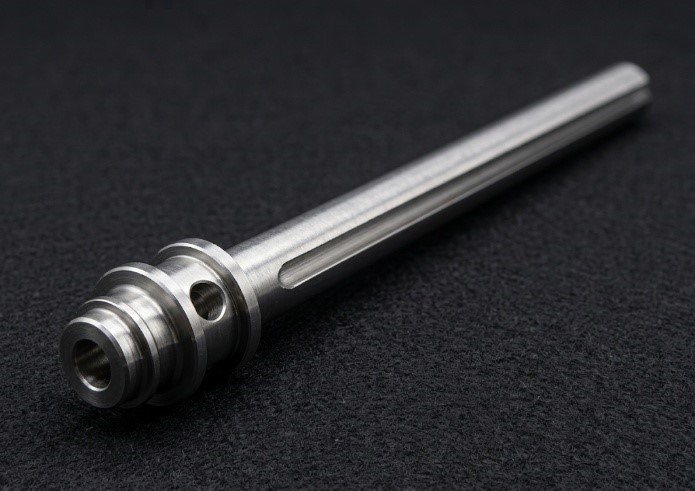
Project Background
• Client Industry: Outdoor security locks and safe security systems.
• Product Name: High-Precision Outdoor Lock Shaft Core.
• Key Specifications: Total length of 130 mm divided into a head section and a 120 mm long main shaft section (6 mm diameter) featuring a deep longitudinal slot along the shaft.
• Functional Requirements: Due to severe outdoor exposure and mechanical locking principles, the shaft requires weather-resistant materials and stringent rotational runout precision.
• Core Engineering Challenge: Extreme aspect ratio cutting elastic deflection caused defect rates exceeding 18.5%. To align with tight production schedules, the client mandated zero delivery returns, high yield performance, and Cpk ≥ 1.33.
Client Pain Points
During initial implementation and prototyping, the project suffered from an unacceptably high defect rate (>18.5%), resulting in excessive material scrap and severe risk to mass production schedules. Key bottlenecks included:
1. Severe Elastic Deflection from High Aspect Ratio: With a 6 mm diameter and a 120 mm shaft length, the aspect ratio reached L/D = 20, making the component highly susceptible to chatter and deflection.
2. Axial Bending from Residual Stress Release: Machining a single-sided longitudinal slot 3 mm deep removed approximately 33.3% of the cross-sectional area. Single-pass milling disrupted residual stress equilibrium in cold-drawn SUS303 bars, inducing thermal distortion and micro-bending.
3. Overly Stringent Geometric Tolerances: Original drawings specified total radial runout ↗ Ø0.05 mm across the entire 120 mm length referenced from the head section—frequently exceeding limits despite guide bushing support.
4. Raw Material Outer Diameter (OD) Fluctuations: Minor OD tolerances in stainless steel bars destabilized workholding; over-clamping scratched the surface, while under-clamping allowed axial vibration.
Core Technologies
• Dual-Channel Swiss CNC & Sub-Spindle Synchronization: Optimized dual-channel toolpaths synchronized with the sub-spindle to minimize vibration and deflection during long-shaft cutting.
• Progressive Residual Stress Release: Modified cutting energy distribution using multi-pass progressive milling to prevent sudden internal stress disruption.
• DFM Tolerance Rationalization: Evaluated actual assembly mechanics to translate geometric tolerances without compromising functionality.
• Low-Force Measurement & MSA Validation: Utilized specialized V-block fixtures and low-force eccentric gauging to eliminate elastic deformation during inspection, verified by Measurement System Analysis (MSA).
Implementation Strategy
Cross-functional collaboration between QA and Manufacturing Engineering addressed these challenges across four key dimensions:
Countermeasure 1: DFM Communication & Tolerance Rationalization
Engineering contacted the client to review the shaft's real-world lock mechanism. Demonstrating the physical constraints of cutting stress on total runout, we proposed updating the callout from total runout ↗ Ø0.05 mm to functional concentricity ◎ 0.10 mm, significantly lowering production and inspection costs.
Countermeasure 2: Residual Stress Control via Progressive Milling
Replaced single-pass 3 mm deep slotting with progressive multi-pass milling. Lowering depth of cut per pass dispersed mechanical stress and thermal accumulation, suppressing axial warping.
Countermeasure 3: Raw Material Inspection & OD Management
Analyzed material variance impacts on dimensional stability, establishing pre-machining sorting protocols for SUS303 bars to eliminate process noise and raise overall yield.
Countermeasure 4: Quality Control Plan & MSA Inspection
Deployed dedicated V-block fixtures with low-force gauges for slender shaft testing. Measurement System Analysis confirmed a %GRR < 10%, verifying gauge repeatability and reproducibility. Hourly sampling monitored runout variations during early mass production, ensuring process capabilities met Cpk ≥ 1.33, supported by daily inline audits to block defective units from reaching assembly lines.
Results & Metrics
• Drastic Defect Reduction: Production yield increased significantly as defect rates dropped from >18.5% during prototyping to under 0.15%.
• Superior Process Capability: Critical concentricity and key parameters achieved Cpk ≥ 1.33.
• Substantial Cost Savings: DFM tolerance rationalization reduced per-unit production and QC inspection costs by 30% to 50%.
• Zero-Defect Delivery Commitment: Standardized QC control plans prevented stress-deformed parts from entering assembly, achieving a 0% return rate upon client receiving inspection.
• Inspection System Optimization: Gage R&R decreased from >30% prior to V-block/low-force gauge implementation to <10%.
Conclusion & Quality Commitment
This case demonstrates our advanced Swiss multi-axis turning/milling capabilities and proactive DFM engineering mindset when handling complex slender metal components. By analyzing material stress dynamics, implementing progressive multi-pass milling, and mitigating process variability, we successfully transformed an unstable prototype into a high-efficiency, high-Cpk production line. If you are experiencing metal deformation, tight geometric tolerances, or yield bottlenecks, contact our engineering team for a cost-effective, high-quality solution!
Related FAQ: Slender-Shaft-Machining-Quality-Control
Have technical questions about our process, geometric tolerance evaluations, Swiss lathe parameter setups, or ISO/IATF quality controls? Explore our FAQ section below for expert insights.
Reliable OEM Parts Solutions
Boomster brings 37+ years of one-stop OEM expertise in metal, plastic parts, CNC, forging, casting, molding, wiring, and assembly with ISO-certified quality.
One-stop OEM service
Complete OEM services from material sourcing, fabrication, custom finish, assembly, package, and global delivery.
ISO-Certified OEM Solutions
Reliable Taiwan OEM for metal, plastic, and electronic parts with ISO 9001 certified quality assurance.
Quality You Can Trust
ISO 9001 certified, Boomster delivers strict quality control with inspection reports traceable for 3 years or longer.
Industries We Serve
Supplying high quality to diverse sectors, from electronics and medical to industrial equipment, ensuring precision and reliability for your specialized needs.
Overcoming Slender Shaft Machining Challenges: Residual Stress Relief and Quality Control Case Study - High-Tolerance OEM Components | Boomster
Boomster is a Taiwan-based OEM manufacturer with over three decades of experience in precision metal and plastic components. Since 1987, we have provided end-to-end solutions that include tooling design, material sourcing, CNC machining, forging, metal injection molding (MIM), stamping, casting, wire harness, and turnkey sub-assembly.
Certified to ISO 9001:2015, Boomster implements strict quality control using CMM, 2D projectors, hardness testers, surface roughness testers, and various gauges to ensure every part meets your specifications. We also support your compliance requirements with documentation such as PPAP, FAI, and SGS reports, making us a reliable partner for automotive, medical, electronics, and industrial applications.
With multilingual support, flexible production volumes, and efficient shipment consolidation, Boomster helps global buyers reduce procurement complexity and total cost. Our team focuses on responsive communication, engineering collaboration, and long-term partnerships, enabling you to develop competitive products with stable quality and on-time delivery.