
Eliminating SUS303 Passivation Defects - Metal & Plastic Component Manufacturing | Boomster
This case study addresses severe white haze and discoloration issues encountered on core safe-locking transmission components following ASTM A967 passivation treatment. Through a systematic root-cause problem-solving workflow, our engineering team precisely calibrated four key process stages: degreasing and cleaning, bath life and chemical control, immersion time kinetics, and acid ratio optimization. This intervention successfully eliminated microscopic over-etching and light scattering on the stainless steel surface, fully restoring a uniform metallic luster. The components subsequently passed rigorous corrosion resistance and torque verification testing, ensuring long-term, fail-safe mechanical operation. Boomster provides high-precision CNC machining services in Taiwan with strict ISO 9001 QC, multi-material expertise, tight-tolerance parts, and global OEM support.
Eliminating SUS303 Passivation Defects
A 4-Stage Process Optimization Meeting ASTM A967 Standards
This case study addresses severe white haze and discoloration issues encountered on core safe-locking transmission components following ASTM A967 passivation treatment. Through a systematic root-cause problem-solving workflow, our engineering team precisely calibrated four key process stages: degreasing and cleaning, bath life and chemical control, immersion time kinetics, and acid ratio optimization. This intervention successfully eliminated microscopic over-etching and light scattering on the stainless steel surface, fully restoring a uniform metallic luster. The components subsequently passed rigorous corrosion resistance and torque verification testing, ensuring long-term, fail-safe mechanical operation.
Case Background
The component in this project serves as the core transmission element (drive shaft) within a commercial safe-locking mechanism. During locking and unlocking cycles, the component is subjected to extreme impact torque and dynamic shear forces.
• Product Application: Core transmission drive shaft for safe-locking mechanisms.
• Material Grade: SUS 303.
• Operating Environment: Housed within enclosed internal safe mechanisms, responsible for transmitting instantaneous mechanical stress during locking and unlocking operations.
• Quality Requirements:
- Instantaneous Torque & Shear Strength: Must withstand frequent, high-impact mechanical loads. The material and thread profiles require exceptional fatigue and shear resistance.
- Long-Term Corrosion Resistance & Zero Jamming: As a critical security asset, the part must deliver decades of reliable service without rust or binding. Environmental crevice corrosion or seizing would lock the safe mechanism permanently, leading to destructive entry scenarios.
• Surface Specification: Must fully comply with ASTM A967 chemical passivation standards.
Client Pain Points
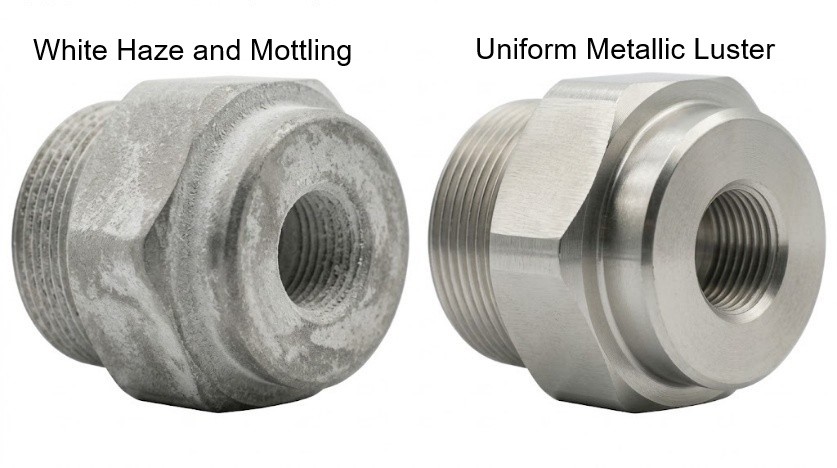
Following standard ASTM A967 passivation treatment, the components exhibited severe white haze and uneven discoloration, failing to display the characteristic uniform metallic luster of stainless steel. This surface defect immediately raised critical concerns regarding the functional efficacy of the passivation layer under ASTM A967:
- Chromium-Depleted Passive Film Concerns: Apprehension that the white hazy film indicated an incomplete passive layer, compromising long-term corrosion protection.
- Structural and Functional Risks: Microscopic pitting on the thread surfaces could impair thread engagement, increasing the risk of binding, galling, or catastrophic failure under peak impact torque.
Core Technology & Four-Stage Troubleshooting Process
To resolve the white haze and discoloration defects on the SUS303 threaded components, we initiated a structured Problem-Solving Process. Collaborating closely with our quality engineering team, supply chain partners, and chemical passivation facilities, we executed root-cause analysis and systematic trials. The corrective actions were structured into a four-stage tiered containment plan, successfully achieving 100% quality resolution:
• Stage 1: Degreasing and Cleaning Optimization ➔ 30% Improvement (Surface residual oils reduced, but localized white haze persisted)
• Stage 2: Passivation Bath Life Control ➔ 60% Improvement (Metallic luster recovered, discoloration area narrowed)
• Stage 3: Immersion Time Fine-Tuning ➔ 85% Improvement (Major visual enhancement, minor color variance remained)
• Stage 4: Acid Ratio Adjustment & SOP Standardization ➔ 100% Improvement (White haze completely eradicated, passed ASTM A967 salt spray testing)
Implementation Details
• Stage 1: Post-CNC Degreasing and Blind Hole High-Pressure Rinsing
- Root Cause: During CNC machining, high-viscosity cutting fluids tended to accumulate in internal geometries and blind holes. When introduced into the acid bath, these trapped oil residues blocked uniform oxide film formation, resulting in surface mottling.
- Corrective Action: Implemented three-stage ultrasonic degreasing paired with targeted high-pressure directional spray flushing to ensure complete removal of heavy oil films.
- Outcome: Surface cleanliness increased noticeably, reducing the white haze area by ~30%. However, uneven surface markings persisted, confirming that oil residue was a contributing factor rather than the sole root cause.
• Stage 2: Passivation Bath Refreshment and Metal Ion Concentration Control
- Root Cause: Inspection of the passivation facility's chemical management revealed that prolonged, repeated use of the acid bath had accumulated excessive dissolved metal ions (Fe2+, Ni2+) and impurities, causing secondary precipitation of metal ions onto component surfaces during reaction.
- Corrective Action: Flushed and refilled the passivation bath with fresh acid, established daily acid-base titration protocols, implemented iron ion concentration control curves, and instituted strict bath replacement thresholds.
- Outcome: Metallic luster rebounded, and mottled areas shrank further (60% improvement), though minor color variations remained visible under specific lighting angles.
• Stage 3: Immersion Time Fine-Tuning and Reaction Kinetics Control
- Root Cause: SUS303 stainless steel is highly sensitive to pickling and passivation exposure times. Excessive immersion duration led to preferential acid attack on manganese sulfide (MnS) inclusions within the steel matrix, triggering micro-pitting, increased light scattering, and white hazy surface appearance.
- Corrective Action: Strictly shortened and tightly controlled acid immersion windows using digital timers and automated hoist systems to eliminate human timing discrepancies.
- Outcome: Visual quality improved significantly (85% improvement), with white haze restricted to negligible patches.
• Stage 4: Acid Ratio Optimization and SOP Standardization
- Root Cause: Pure nitric acid ratios possessed excessive acidity, causing the chemical attack rate on high-sulfur SUS303 to outpace the formation rate of the protective chromium-enriched oxide film, resulting in micro-over-etching of the substrate.
- Corrective Action:
1. Optimized Acid Formulation: Shifted to ASTM A967 Nitric 2 or Nitric 3 standards incorporating sodium dichromate accelerator (or optimized citric acid systems), which rapidly constructs a dense protective oxide film while suppressing excessive base metal dissolution.
2. Standardized SOP Establishment: Integrated pre-treatment, precise timing, and dual-stage pure water rinses into formal Mass Production Standard Operating Procedures (SOPs) to guarantee batch-to-batch stability.
- Outcome: Components fully recovered their uniform stainless steel metallic luster with zero visual color discrepancy against mating parts, achieving 100% quality improvement.
Results
Through this targeted root-cause investigation and manufacturing process refinement, the project achieved the following concrete results:
• Surface Aesthetic Restoration: Completely eliminated white haze and mottling, fully restoring the original uniform metallic luster of the stainless steel.
• Corrosion & Structural Verification: Successfully passed ASTM A967 salt spray testing, guaranteeing long-term corrosion resistance.
• Assembly Quality Assurance: Eliminated visual color mismatch with mating components and verified zero mechanism jamming under prolonged high-frequency impact cycles, earning high praise from the client and securing smooth transition into long-term volume production.
Conclusion
Related FAQ: Solving-SUS303-Passivation-Defects-ASTM-A967- Process-Optimization
Have technical questions about our process? Explore our FAQ section below to dive deeper into our chemical specifications, quality controls, and partnership workflows.
Reliable OEM Parts Solutions
Boomster brings 37+ years of one-stop OEM expertise in metal, plastic parts, CNC, forging, casting, molding, wiring, and assembly with ISO-certified quality.
One-stop OEM service
Complete OEM services from material sourcing, fabrication, custom finish, assembly, package, and global delivery.
ISO-Certified OEM Solutions
Reliable Taiwan OEM for metal, plastic, and electronic parts with ISO 9001 certified quality assurance.
Quality You Can Trust
ISO 9001 certified, Boomster delivers strict quality control with inspection reports traceable for 3 years or longer.
Industries We Serve
Supplying high quality to diverse sectors, from electronics and medical to industrial equipment, ensuring precision and reliability for your specialized needs.
Eliminating SUS303 Passivation Defects - High-Tolerance OEM Components | Boomster
Boomster is a Taiwan-based OEM manufacturer with over three decades of experience in precision metal and plastic components. Since 1987, we have provided end-to-end solutions that include tooling design, material sourcing, CNC machining, forging, metal injection molding (MIM), stamping, casting, wire harness, and turnkey sub-assembly.
Certified to ISO 9001:2015, Boomster implements strict quality control using CMM, 2D projectors, hardness testers, surface roughness testers, and various gauges to ensure every part meets your specifications. We also support your compliance requirements with documentation such as PPAP, FAI, and SGS reports, making us a reliable partner for automotive, medical, electronics, and industrial applications.
With multilingual support, flexible production volumes, and efficient shipment consolidation, Boomster helps global buyers reduce procurement complexity and total cost. Our team focuses on responsive communication, engineering collaboration, and long-term partnerships, enabling you to develop competitive products with stable quality and on-time delivery.